

Since the 1980’s, the concept of ‘Artificial Intelligence’ has been debated on its merits of either advancing society or being the eventual end of mankind.
I’m not willing or ready to join that debate nor is this the proper forum to do so, but what I will discuss is Google’s semi-new automated bidding strategies.
For those Google advertisers with the time and the knowledge to properly segment and optimize their Google Ads campaigns, typically you will generate better results and gain important insights not available when you manually segment, optimize and actively manage your campaigns.
However, like anything, you won’t know for sure if optimizing campaigns manually is more effective than Google’s automated bidding strategies if you don’t test. I recommend and I am always testing different bidding strategies for my private clients and I suggest that you do the same.
I’m not proposing that you test your entire account, but a subset of your account that may not be performing well or at least is not your most essential account during your busiest time of year make excellent candidates for testing:>
A quick note when testing is that you will want to understand the bidding strategies before running any test so pay attention to the rest of this article and discover which strategy may be the right fit for you and your advertising goals.
And for those of you who lack the time or knowledge to properly optimize your campaigns (if you are reading this article) know that using a Google automated bidding strategy is going to far outperform doing nothing, so know your options.
Automated Bidding Strategies – What They Are
In general, the purpose of Google’s automated bidding strategies is to automatically set bid values in order to maximize the likelihood that a click on your ad will result in a conversion.
In order to calculate the likelihood of conversion, Google uses past historical data including search terms, click through rates, device, operating system, time of day, etc. to either increase or decrease bids in real-time based on the selected bidding strategy.
For automated bid strategies to be effective, advertisers will first need to ensure that they have properly configured their conversion tracking and then that they have established conversion history and know their campaign goals.
Automatic bid strategies can be changed easily through the settings link at either the campaign, ad group or keyword level depending on the strategy.
By using automated bidding strategies, advertisers are addressing two problems that can be commonly found within manually optimized campaigns.
- Ensuring that bids are set high enough to compete with other qualified advertisers.
- Ensuring that bids are not set too high which can result in ads being shown on too loosely relevant of user queries where there is little likelihood of purchase.
Note, we are discussing the automated bidding strategies, which are not to be confused with Google’s Smart Shopping Campaigns.
For information on Google Smart Shopping Campaigns, see my article – New Google Smart Shopping Campaigns – What You Need to Realize.
Types of Automated Bidding Strategies
Google offers six different automated bidding strategies – Target CPA, Target ROAS, Maximize Clicks, Maximize Conversions, Maximize Conversion Value and Target Impressions Share.
All six of these campaigns are available for use in Search campaigns, while only two automated bid strategies are currently available for Shopping campaigns – Target ROAS and Maximize Clicks.
My feeling is that soon all the automated bid strategies will become available in Shopping campaigns. Therefore, even if your Google Ads account is predominantly Shopping campaigns it is advisable to know the difference between the automated bidding strategies and to even test how they work and their effectiveness within your Search campaigns.
TARGET CPA
The lingo – CPA – Stands for Cost per Acquisition. In other words, what is the average amount it costs you to generate a sale.
The strategy – Google automatically will adjust an advertiser’s bid in order to get as many conversions possible at the advertiser’s selected cost per acquisition goal.
Where it is available – campaign and ad group levels.
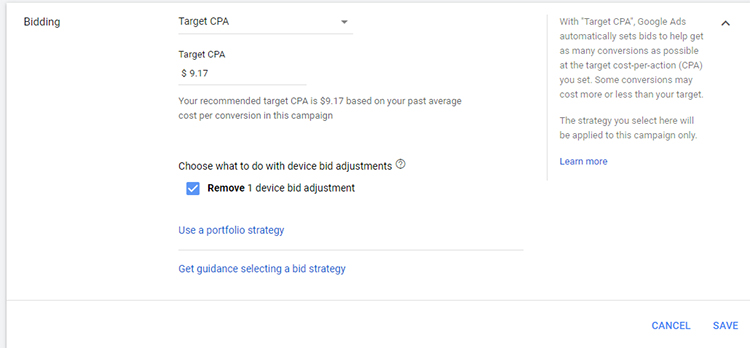
When to use – This strategy works best when you already have an established CPA with over 30 conversions in the last 30 days. You can use this strategy to either lower your CPA or to maximize conversions by setting the Target CPA slightly higher than your last 30-day average. Note, this strategy will remove any location/device bid adjustments that are currently active.
TARGET ROAS
The lingo – ROAS – Stands for Return on Ad Spend. To calculate ROAS divide gross revenue by ad spend.
The strategy – Google automatically will adjust an advertiser’s bid in order to get as many conversions possible at the advertiser’s selected ROAS goal.
Where it is available – campaign, ad group and keywords levels. (Shopping & Search Campaigns).
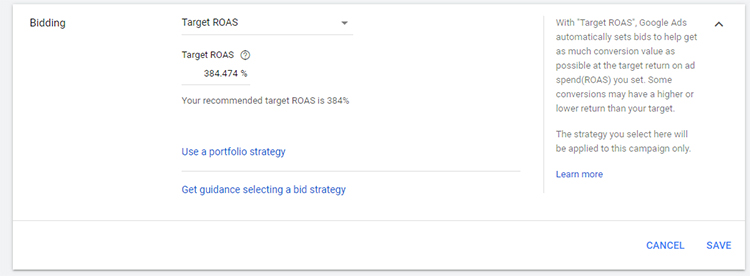
When to use – This strategy works best when you already have an established ROAS with over 50 conversions in the last 30 days. In addition, this strategy makes sense only when conversions have different conversion values.
MAXIMIZE CLICKS
The lingo – A click is calculated each time a user clicks on your ad and is directed to your website.
The strategy – Google automatically will adjust an advertiser’s bid in order to get as many visitors as possible to your website within your set budget.
Where it is available – campaign, ad group & keyword levels. (Shopping & Search Campaigns).
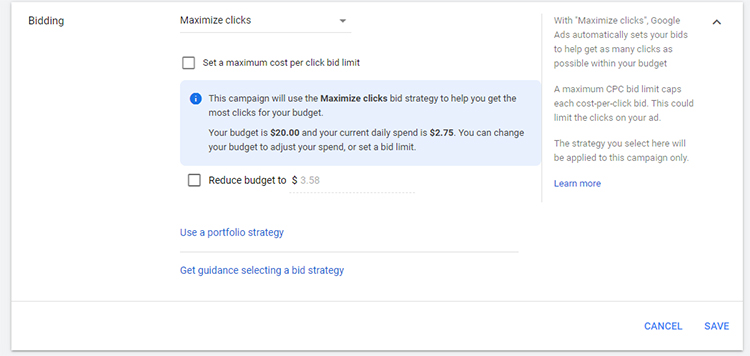
When to use – You have a historical high conversion rate and you would like as many visitors as possible sent to your website.
MAXIMIZE CONVERSIONS
The lingo – A conversion is what the advertiser defines as their end goal. For eCommerce retailers this is typically a product purchase. For others, a conversion could be as simple as joining a mailing list.
The strategy – Google automatically will adjust an advertiser’s bid in order to get as many conversions within the set budget.
Where it is available – campaign level.
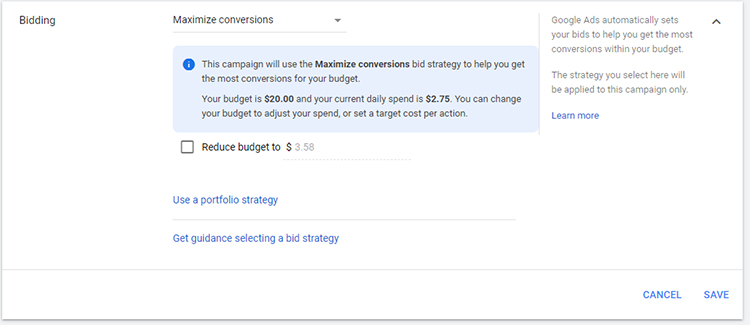
When to use – You have a reasonably large budget and wish to generate as many conversions as possible.
MAXIMIZE CONVERSION VALUE
The lingo – The conversion value is the total value of all conversions.
The strategy – Google automatically will adjust an advertiser’s bid in order to gain the maximum conversion value within the set budget.
Where it is available – campaign level.
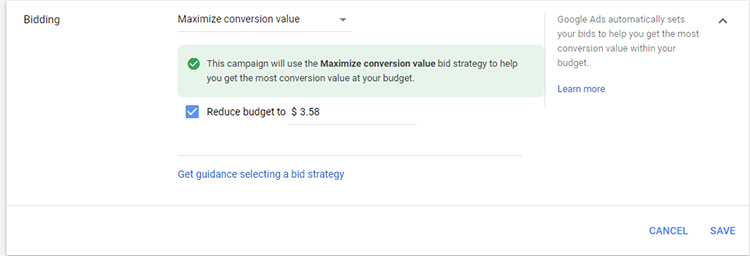
When to use – You have a reasonably large budget with conversions of drastically different conversion values.
TARGET IMPRESSION SHARE
The lingo – Target impression share is the percentage of time your ads appear at the top of the page.
The strategy – Google automatically will adjust an advertiser’s bid in order to generate ad placement at the top of the page as often as possible within the set budget.
Where it is available – campaign level.
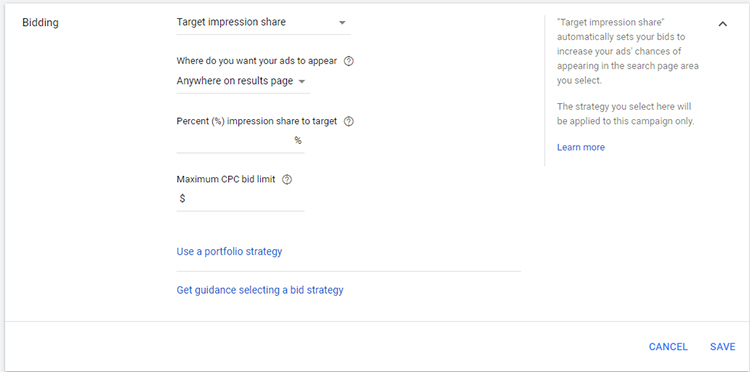
When to use – You have a reasonably well performing conversion rates with a reasonably large budget but are struggling with how often your ads appear at the top of the page.
Final Word
You probably have heard the phrase ‘All Roads Lead to Rome’?
This is true when optimizing your Google campaigns, as there are many ways to achieve your goal of conversions. However, although there are many ways to achieve conversions some will perform better than others.
By better, does that mean lowering your cost-per-acquisition or increasing the number of conversions?
The key metrics that matter are going to depend on your goals as an advertiser and how you wish to best utilize Google in your advertising.
However, whether manually optimizing or using one of Google’s automated strategies it will require testing to discover which strategy performs the best based on your advertising goals.
Looking for More Information on Google Advertising?
Check out the all new The Academy of Internet Marketing (www.theacademyofinternetmarketing.com), the premier online marketing destination for small to mid-sized e-commerce businesses serious about substantially growing their online sales plus exclusive access to me, author of Make Each Click Count, The TOP Guide To Success Using Google AdWords.

If you have the dedication and are ready to take your online sales to the next level, then The Academy of Internet Marketing was created for you. It provides the tools in the form of knowledge of what works today. Join us and see what makes us special and together we will grow your business.
If you are ready to take your online advertising to the next level, I welcome you to take a trial. It only costs $1 for access.
Happy Marketing!
Andy Splichal
ABOUT THE AUTHOR:

Andy Splichal is the founder of True Online Presence, the founder of The Academy of Internet Marketing, author and certified online marketing strategist with twenty plus years of experience helping companies increase their online presence and profitable revenues. To find more information on Andy Splichal, visit trueonlinepresence.com or read The Full Story on his blog, blog.trueonlinepresence.com