
Cross-Channel Attribution—it’s the question I get asked more than what’s for dinner.
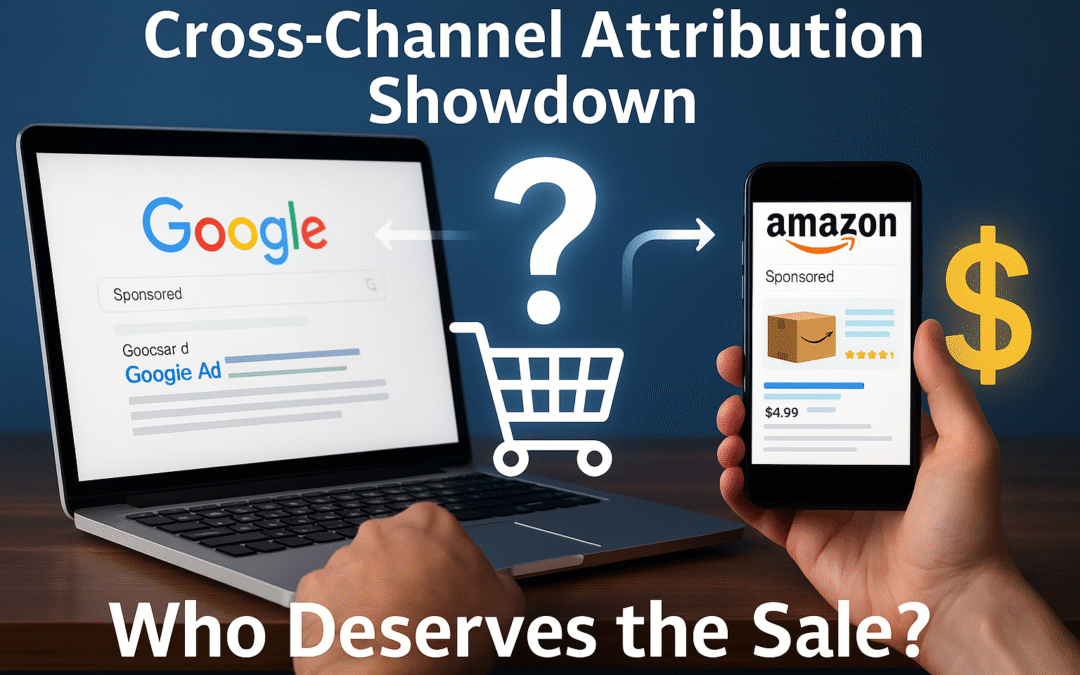
“Andy, if someone clicks my Google Ad, then buys on Amazon… who gets the credit?”
Well, my friend, that’s like figuring out which of your kids left the back door open—everyone’s pointing fingers, and the AC’s been running like it’s cooling the Mojave Desert. 😤
In today’s post, we’re diving headfirst into cross-channel attribution: what it means, why it’s critical, and how you can finally stop guessing and start making smarter moves with your ad spend.
🔍 What Is Cross-Channel Attribution?
Here’s the deal:
Cross-channel attribution is the detective work of digital marketing. You’re trying to figure out which ad (or ads) deserve the credit for a sale when your customer touches multiple points along their journey.
Let me paint you a picture (this happens all the time):
- 🚀 Shopper sees your Google Shopping ad
- 👀 Later sees a Facebook retargeting ad
- 🛒 Then searches your brand on Amazon
- 📱 Clicks your Amazon Sponsored Product ad
- 💳 And finally… makes the purchase
So who deserves the high five? Google? Facebook? Amazon?
Answer: It depends.
And that’s where things get interesting.
📉 Why You Must Get Attribution Right
If you mess this part up, here’s what happens:
- You scale the wrong channel 🚫
- You kill what’s working 💀
- You misread your entire ROI 📉
As I say in the Make Each Click Count series:
“You can’t optimize what you can’t measure.”
And in attribution? That’s gospel.
🥊 The Amazon vs. Google Ads Showdown
Here’s why it’s so tricky…
Amazon is a closed ecosystem.
That means if someone clicks a Google ad but buys on Amazon, your Google dashboard sees… zilch. Nada. It’s like that customer never existed.
And vice versa. If someone sees your Amazon Sponsored Brand ad but buys from your Shopify store, Amazon doesn’t know either.
It’s a marketing Bermuda Triangle, folks. 🌊
🔍 My Attribution Framework: “Follow the Click Trail”
Step 1 – Know Your Attribution Windows
Each platform tracks differently:
- Google Ads: Last click by default (but can be switched)
- Amazon Ads: 14 or 30-day window
- Facebook/Meta: 7-day click / 1-day view
🧠 Pro tip: These can and do overlap. That’s how you end up double-counting conversions.
Instead, compare revenue impact, not just conversion data.
Step 2 – Use Amazon Attribution (Yes, Even for Google Traffic)
Yup, Amazon lets brand-registered sellers tag their external traffic.
You can now create Amazon Attribution links for Google Ads, email, social, and track how many clicks—and conversions—came from those sources.
Is it perfect? Nope. But it’s a giant step forward in answering the “who gets credit?” question.
Step 3 – Use the “First Touch / Last Touch” Model
Here’s how I coach my clients:
- First Touch = Who got the customer to notice you (🧐)
- Last Touch = Who closed the deal (💰)
Let’s say:
- Google Shopping = First Touch
- Amazon Sponsored Products = Last Touch
➡️ I give 60% credit to Amazon, 40% to Google.
You can flex the split, but the model keeps you from making emotional (aka expensive) decisions.
🛠️ Tools You Should Be Using
If you’re serious about getting this right, check out these tools:
- 🛍️ Amazon Attribution (free if brand-registered)
- 📊 Google Analytics 4 (look at Assisted Conversions)
- 🧠 Triple Whale / Northbeam / Segmetrics (powerful, 3rd-party tracking)
- 📋 Post-purchase surveys (ask: “Where did you hear about us?” – You’ll be surprised!)
🧠 Big Lesson: Attribution Is a Guide, Not a Gospel
Let me be real with you—attribution is never perfect.
You’re juggling:
- Different platforms
- Different devices
- Different timelines
- And customers who can’t remember what they had for lunch yesterday, let alone which ad they clicked
So here’s the key:
👉 Use attribution to spot patterns. Not to assign blame.
Ask yourself:
- What channel introduced them?
- What channel converted them?
- Are both profitable?
If the answer is yes?
🔥 Scale both.
📜 Marketing Proverb of the Day
“Don’t cut off your left arm because your right hand shook on the handshake.”
Both hands (aka channels) brought in the win.
❓ 7 Must-Know Q&A for Attribution
- What’s the best way to track Google Ads traffic to Amazon?
Use Amazon Attribution links for Google Ads campaigns targeting Amazon product pages.
- How can I track Amazon ad influence on my Shopify store?
You can’t directly, but post-purchase surveys and trends in branded search help.
- What if Google and Amazon both show a sale for the same order?
That’s double-counting. Use revenue impact (not just platform-reported conversions) for decisions.
- How does Amazon PPC fit into cross-channel attribution?
It often acts as the last-touch—the closer in your sales funnel.
- Should I stop using Google Ads if Amazon performs better?
No! If Google introduces the customer, it’s still part of the sale journey.
- Can I use attribution models in Google Analytics?
Yes. GA4 allows custom attribution with Assisted Conversions.
- What if I don’t have time to manage all this?
That’s where I come in. Reach out to True Online Presence—we’ll get your clicks in order.
Need Help with Google Ads? If you’re ready to take your online store’s performance to the next level with Google Shopping Ads but need a helping hand, consider reaching out. I’m Andy Splichal, author of Make Each Click Count and host of the Make Each Click Count podcast. Whether it’s about creating high-performing Shopping Ads or mastering your overall Google Ads strategy, I’m here to help. Let’s make those clicks count!
ABOUT THE AUTHOR

Andy Splichal is the founder and managing partner of True Online Presence, author of the Make Each Click Count book series, host of the Make Each Click Count podcast, founder of Make Each Click Count University and certified online marketing strategist with twenty plus years of experience helping companies increase their online presence and profitable revenues.
He was named to Best of Los Angeles Awards’ Most Fascinating 100 List in both 2020 and 2021. To find more information on Andy Splichal, visit trueonlinepresence.com or read The Full Story on his website or his blog, blog.trueonlinepresence.com.
